Knock Off Rolex Watches for Australia’s Watch Enthusiasts
9002 vs 3135 vs 3235: An Honest Comparison for Australian Replica Rolex Buyers
Most replica reviews are written by people who have never opened a caseback. They copy specs from a dealer page, list a few bullet points, and call it a buying guide. I have bought, worn, and serviced enough replica watches over the past six years to know that this approach does not help anyone decide where to spend $400 to $700. What follows is the analysis I wish existed when I started: a practical, experience-based look at knock off rolex watches for Australian buyers, with one movement, the 9002, as the anchor point.
I currently buy through replicafactory.cx, which I have used for three orders over the past 18 months. The reason is not price. It is consistency. Every watch has matched the listing photos, the movements have been what was advertised, and shipping to Australia has cleared customs without drama. That track record matters more in this market than any single spec sheet.
Why Movement Choice Decides More Than Factory Name
Most buyers start with the same question: which factory is best? Clean or VSF? That question is not wrong, but it is out of order. The factory decides the case, dial, and bracelet execution. The movement decides how the watch actually behaves over the next three years. I have bought enough rolex replica watches and been burned by enough “best factory” samples that ran 20 seconds fast per day to stop choosing a watch by factory first. I choose the movement first, then find which factory executes that movement well.
The reason comes down to one fact: the movement is the only part of the watch that degrades. The case does not loosen. The dial does not fade. The ceramic bezel does not lose its shine. But the movement does. Lubricants break down, amplitude drops, and timekeeping drifts. If the movement fails after three years and there are no parts to fix it, the watch becomes a drawer ornament. This is true of any replica watches, no matter how good the exterior looks on day one.
A common scenario I have seen play out multiple times: a buyer spends $450 on a “Clean Factory” Submariner because every review says Clean has the best finishing. The watch arrives, the exterior is excellent, and the factory reputation is deserved. But the buyer never asked what movement is inside. Eighteen months later, the watch is running 30 seconds slow per day, a local watchmaker quotes $150 to service it if they will touch it at all, and the factory name does nothing to solve the problem. The money spent on the better exterior would have been better spent on a movement with a longer service track record.
This is why movement choice should come before factory choice. The factory name answers “how good does it look when I open the box?” The movement answers “how good does it work after a year of daily wear?” Those two questions are not equally important.
What a Movement Actually Is, and Why It Matters More Than the Label
A movement is the engine of the watch. It converts stored energy from the mainspring into regulated timekeeping through a train of gears, a balance wheel, and an escapement. In the replica market, movements fall into three tiers: decorated generic movements, where a common base like a Seagull or a Miyota is dressed up to look like something else; hybrid movements, where a different base is modified with decorative plates to mimic a Rolex caliber; and true clone movements, where the architecture is reverse-engineered to match the genuine.
Only the third tier is worth discussing for anyone spending real money. A decorated generic movement can look acceptable on a spec sheet, but its geometry is wrong, its service parts are mismatched, and its long-term behavior is unpredictable.
Why does this matter to an Australian buyer specifically? Because local watchmakers are the ones who will eventually service your watch. Independent watchmakers in Sydney, Melbourne, and Brisbane will generally work on clone movements with clear architecture and available parts, especially the 3135 and 2824 families. They are far more reluctant to touch movements where the structure is unclear or the parts cannot be sourced. The movement you choose determines whether your watch can be maintained locally or has to be shipped back to Asia for every service.
The practical impact is simple. A watch with a well-understood clone movement costs $50 to $80 to service locally and can run reliably for years. A watch with an obscure movement becomes a disposable object. You are not just buying a movement. You are buying access to future maintenance.
The 9002, 3135, and 3235: A Field Comparison
The 9002 Clone: What It Actually Is and How It Runs
The genuine caliber 9002 is the current-generation movement inside the Rolex Sky-Dweller. It is a dual-time, annual-calendar automatic with a 72-hour power reserve, 40 jewels, and a 4 Hz beat rate. It replaced the caliber 9001 in 2023, adding the Chronergy escapement and a redesigned oscillating weight. In simple terms, it is one of the most complex movements Rolex makes, and that complexity is exactly why the replica version deserves scrutiny.
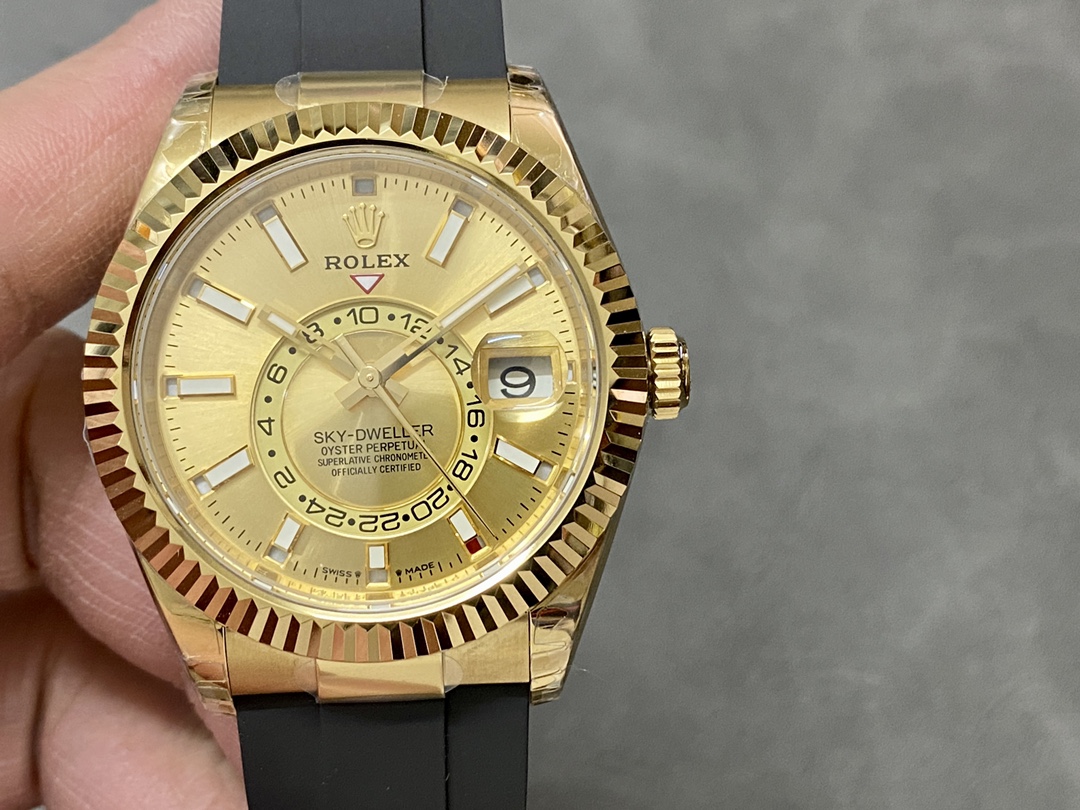
The replica 9002 is a true clone, not a decorated generic. I had one inspected by a watchmaker in Melbourne last year, and his assessment was direct: the bridge layout, rotor design, and jewel positions all match the genuine closely enough that someone familiar with the original can identify the architecture without a loupe. The gear train geometry is correct. The escapement is a legitimate clone, not a cheap approximation. He could service it using standard 9000-series components, which is not something you can say about every clone movement in this market.
Power reserve on the replica is rated at 70 to 72 hours, and in practice it lands between 68 and 72 hours depending on how fully wound the mainspring is when you take the watch off. You put it down on Friday evening and pick it up Monday morning, and it is still running. That is the test that matters in daily use, and the 9002 passes it.
In terms of real-world stability, my 9002-equipped watch ran about 6 to 8 seconds fast per day for the first two weeks. After a single regulation, it settled into plus or minus 3 seconds per day. That is excellent for a clone movement. The trade-off is complexity. The annual calendar mechanism is intricate, and if the date change ever goes wrong, not every local watchmaker will want to disassemble it. This movement suits a buyer who is willing to get an initial regulation and knows where to send the watch for future service. It is not for someone who wants a completely maintenance-free object.
The 3135 Clone: The Known Quantity
The cloned 3135 is the safest choice in the replica market, and that is not a controversial statement. The Dandong 3135 has been in production long enough that its reliability is well documented, with users reporting lifespans exceeding four years without major service on well-maintained examples. It runs at 28,800 vph with 31 jewels and a 48-hour power reserve. Parts availability is excellent. Almost every watchmaker who works on replica movements knows this caliber.
Why does this matter? Because the 3135 is not the most impressive movement on paper, but it is the easiest to live with. A watch that develops a problem after two years and can be fixed locally for $60 is a fundamentally different ownership experience from a watch that cannot be fixed at all. The 3135’s architecture is so widely understood that even watchmakers who do not advertise replica-friendly policies will often take the job.
For Australian buyers specifically, the 3135 is the lowest-risk option because it minimizes the two biggest long-term costs: service difficulty and downtime. If you are buying a Submariner or GMT-Master II with a closed caseback, you will never see the movement. In that situation, paying extra for a more complex clone makes no sense. The 3135 delivers the same visual experience and better long-term practicality.
The 3235 Clone: When the Numbers Do Not Tell the Whole Story
The cloned 3235 looks like the most attractive option because it advertises a 70-hour power reserve, matching Rolex’s current-generation calibers. The problem is that the longer mainspring required for that extended reserve puts more stress on the escapement over time. I have followed several examples where amplitude dropped more noticeably after 12 to 18 months compared to a 3135, and timekeeping stability degraded alongside it. The service interval tends to be shorter, not longer.
This does not make the 3235 a bad movement. It makes the 70-hour number misleading. For someone who wears the watch daily, there is no practical difference between a 48-hour and a 70-hour reserve, because the watch never runs down. The power reserve only matters if you regularly take the watch off for two or three days at a time. If you are that kind of wearer, the 9002 or the 3235 both make sense. If you wear the watch every day, the 3135’s 48 hours is more than enough, and you avoid the long-term trade-offs.
Factory Comparison: Clean Factory vs VSF
Clean Factory and VSF dominate the high-end rolex replica market in 2026, but they are not interchangeable. Clean Factory’s strength is exterior finishing. It uses 904L steel cases and cloned VR3135, VR3186, and VR4130 movements, and its ceramic bezel execution is the best in the business. The engraving depth and luster are things flat fakes cannot replicate, and the dial printing holds up under magnification. If you are buying a Submariner, GMT-Master II, or Daytona, Clean is the default recommendation for a reason.
VSF’s strength is movement depth and detail tuning. It is the only factory producing a credible cloned Co-Axial movement for Omega replicas, and its Rolex work focuses on the Daytona and select Submariner references. VSF’s crystal clarity and case proportions are often described as the most natural on the wrist, and its movement execution is the deepest in the niche. The trade-off is a narrower catalog and exterior finishing that does not always match Clean’s bezel work.
When it comes to the 9002 specifically, availability is more limited than with the 3135 or 3235. The factories producing 9002-equipped watches tend to be the ones with stronger movement engineering programs, which is a positive signal. A factory willing to produce a complex annual-calendar clone is not cutting corners elsewhere.
One common mistake is assuming that a higher-priced listing from a specific factory guarantees a better watch. In my experience, sample variance within a factory is real. A strong Clean sample can beat a weak VSF sample and vice versa. This is why buying from a dealer who actually inspects the watch before shipping matters more than the factory name on the protective plastic.
Three Mistakes Australian Buyers Keep Making
Mistake 1: Trusting the Factory Label Without Verifying the Reference
Clean Factory owns the modern 41mm Submariner line. AR Factory owns the discontinued 40mm line. If you buy a 40mm Submariner from a listing labeled “Clean Factory” without checking the reference, you are either getting an older stock watch, a relabeled AR, or something worse. Factory codes describe what a factory is known for, not what any individual listing contains. Verify the specific reference against the factory’s known production before you pay.
Mistake 2: Treating the Movement as Maintenance-Free
A cloned 9002 is a mechanical movement with hundreds of parts. It needs regulation after the first few weeks of wear, and it benefits from a service every two to three years depending on use. The buyers who complain about accuracy two years in are almost always the ones who never had the watch regulated or serviced. A $50 regulation at a local watchmaker can transform a mediocre-performing clone into one that keeps time within seconds per day. This is not an optional step. It is part of owning a mechanical watch.
Mistake 3: Underestimating Australian Customs
The Australian Border Force works with brand owners to detect counterfeit luxury items, and penalties for importing counterfeit goods start at AUD 66,600 in fines, with imprisonment possible in aggravated cases. Undervaluing a shipped watch to dodge charges voids insurance and invites seizure. The classic seizure-plus-penalty case is a buyer who declared a $500 watch as a $50 gift.
Goods valued at AUD 1,000 or less are generally duty-free, but GST at 10% applies to all low-value imported goods as of July 2018. In practice, a $500 replica watch clears without duty but with GST collected. The practical impact is minor. What matters more is the shipping method. High-value watches should travel by insured courier with formal customs entry. Postal channels cap indemnity far below the value of even a mid-tier replica, and if the watch is seized, you have no recourse.
From my own experience, the watches I have ordered through replicafactory.cx have arrived via courier with accurate declarations. The packaging was discreet, the watches were individually wrapped, and there was no customs delay. That is the outcome you want. The risk is not the purchase itself. The risk is choosing a seller who ships without tracking, undervalues the declaration, or uses a postal channel where a seizure means a total loss.
For anyone exploring options, browsing a curated selection of best replica watches before committing to a specific model and dealer is a reasonable first step. But the dealer relationship matters more than the catalog. A seller who has shipped to Australia before, understands the declaration requirements, and can provide tracking is worth paying a small premium for.
Wrist Test vs Macro Test: Why Movement Specs Are Overrated
Here is the analysis I have not seen anywhere else. The replica community has a fixation on macro-level accuracy: how a movement looks under a loupe, how a dial prints at 10x magnification, how a bezel insert compares to a genuine under laboratory lighting. These tests matter for collectors who handle watches under magnification. They do not matter for the vast majority of buyers who wear a watch on their wrist.
I call this the wrist test versus the macro test. The wrist test is simple: put the watch on, wear it for a week, and see how it feels. Does the bracelet articulate smoothly? Does the case sit comfortably? Does the movement keep time well enough that you are not resetting it every morning? Does the watch look convincing from conversational distance, which is how 99% of people will ever see it?
The macro test answers a different question: is this watch indistinguishable from a genuine under a jeweler’s loupe? That is a legitimate question for a collector. It is not a legitimate question for someone who wants a high quality fake rolex to wear to dinner.
The practical implication is that movement specifications should be weighted by how you actually use the watch. If you wear a watch daily and never open the caseback, the visual architecture of the movement is irrelevant. What matters is stability, power reserve, and serviceability. A 3135 clone with a 48-hour reserve that runs reliably for four years is a better daily-wear choice than a 3235 clone with a 70-hour reserve that needs servicing every 18 months.
If you are buying a watch with a display caseback, the equation changes. Movement architecture becomes part of the product. That is where the 9002 justifies its premium: it is the only clone in its class that can be shown through a caseback without looking wrong.
Most buyers do not need the most accurate movement. They need the most reliable one for their wear pattern. That distinction would save a lot of people a lot of money and frustration.
What I Would Tell a Friend in Australia
If you are buying a Sky-Dweller clone or a Datejust with a display caseback, the 9002 is the only movement that makes sense. The visual accuracy is there, the power reserve is practical, and the serviceability is better than the 3235 over the long term. Buy it.
If you are buying a Submariner or GMT-Master II with a closed caseback, the 9002 is not worth paying extra for. You will never see it. Choose the 3135 for the reliability track record and the parts availability. Save the money for a better bracelet or a proper regulation service.
If you are buying your first replica watches and you are unsure about the maintenance commitment, the 3135 is still the safest entry point. It is forgiving, it is well understood by watchmakers, and it holds up to neglect better than the alternatives.
The 9002 is not the universally best movement. It is the best movement for a specific category of watches and a specific type of buyer. Understanding which category you fall into is the actual decision. And if you are still comparing sellers, the best starting point is the one that has already proven it can deliver to Australia without drama.
FAQ
Is the replica 9002 a true 1:1 clone of the Rolex caliber 9002?
It is architecturally very close. The bridge layout, rotor design, and key component positions match the genuine closely enough that a watchmaker familiar with the original can identify the clone without a loupe. It is not a decorated generic movement. However, “1:1” is a marketing term in this market, not a measurable specification. No clone is identical to the genuine in every tolerance.
How long does the power reserve actually last in daily use?
Around 68 to 72 hours in practice, depending on how fully wound the mainspring is when you take the watch off. That matches the genuine specification closely enough that most buyers will not notice a difference. If you wear the watch daily, you will never hit the bottom of the reserve.
Can an Australian watchmaker service a 9002 clone?
Yes, but you need to choose the watchmaker carefully. Not every local shop will work on replica movements. The ones that do will typically charge the same as a service on a comparable Swiss movement. The advantage of the 9002 over the 3235 is that the gear train geometry is correct, which means standard 9000-series components can be used for many service operations. The 3235’s longer mainspring and different escapement geometry make parts sourcing more difficult over time.
Will my watch be seized by Australian customs?
Counterfeit goods are prohibited imports, and the Australian Border Force does seize shipments. In practice, single-watch orders shipped via courier with accurate declarations have a lower interception rate than bulk shipments or postal channel deliveries. The risk is real but manageable. Buying from a dealer with a track record of shipping to Australia is the single most important risk-reduction step.
Which factory makes the best 9002-equipped watches?
The factories producing 9002 clones are the ones with stronger movement engineering programs, which generally means Clean Factory or VSF depending on the reference. Clean’s exterior finishing is stronger; VSF’s crystal and case proportions are more natural on the wrist. For a 9002 watch specifically, verify the movement inside the specific listing rather than assuming based on the factory name.
How often should a 9002 clone be serviced?
Every two to three years with regular wear. Cloned movements use lubricants that break down faster than the oils in genuine Swiss movements. A $50 to $80 service at a local watchmaker, including regulation, will keep the movement accurate and extend its lifespan significantly. Skipping service is the most common reason clone movements develop accuracy problems after the first year.
Is it worth paying more for a 9002 over a 3135 in a closed-caseback watch?
No. If you cannot see the movement, the visual accuracy advantage of the 9002 is irrelevant. The 3135 has a longer reliability track record and better parts availability. Put the price difference toward a better bracelet or a professional regulation instead.
What is the single biggest mistake first-time buyers make?
Buying based on the factory name alone without verifying the specific reference and movement inside the individual watch. Factory codes describe what a factory is known for, not what every listing contains. Always ask the dealer to confirm the movement caliber and the reference number before you pay.